

🎧⠀Listen and follow
Introduction:
OKR is a flexible framework for any industry.
Are you wondering if OKRs are right for your organization? OKRs, Objectives and Key Results, have long been an essential tool for tech giants like Intel, Google, Apple, and Microsoft. But can they work for other organizations like governments, healthcare, nonprofits, manufacturing, and service organizations?
The short answer: Absolutely. Below, we explore why OKRs are so adaptable—and how they’re being used across sectors to drive clarity, alignment, and measurable impact.
New to OKRs? see “What is OKR?”
OKR is a Bendable Framework
By “Framework” we mean that OKR is a set of guidelines, concepts and general strategies – it is not a rigid set of rules and regulations. Many OKR literatures will attest that OKRs can adapt to you, not the other way. OKRs bend to your culture, cadence and constraints.
Find out more “Hybrid OKRs: let OKRs Adapt to You“

OKRs are about the numbers.
The movie Moneyball follows a baseball team as it shifts from decisions based on intuition and experience to decisions driven by data analytics. That shift didn’t just change baseball—it influenced nearly every professional sport.
OKRs bring that same numbers‑driven approach to organizational strategy. Any industry that tracks metrics—performance, engagement, or outcomes—can benefit from OKRs.
OKR is conceptually easy to understand and visualize.
Are OKRs difficult to understand and implement?
At a high level, OKRs are easy to grasp because they form a simple hierarchy of goals. That’s why many organizations are quick to try them.
However, there are nuances in methodology that needs practice. Effective OKR requires time, effort, and often a good coach to guide the process.
When done well, OKRs align seamlessly with strategic corporate goals and cascade clearly to frontline teams. This visual clarity makes the framework appealing across industries.
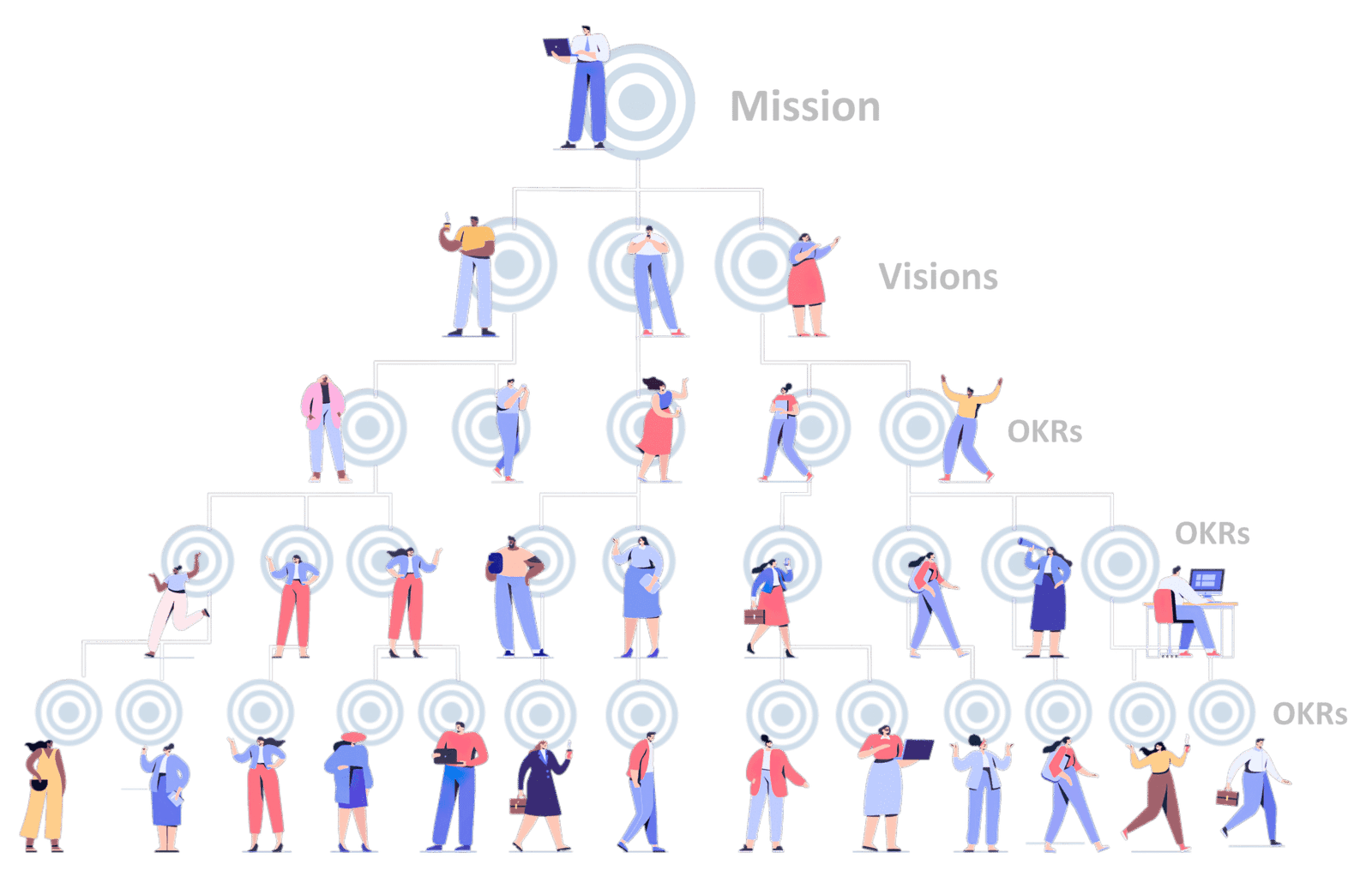
Simply aligned and organized.
OKRs are good for organizations that use KPIs
Can OKRs adapt to companies that use KPIs? Yes, very easily.
In Taiwan and elsewhere, KPIs are widely used to measure the health of a company or track performance goals. But KPIs often lack context: they show what needs to happen, not how or why. OKRs fill that gap by aligning cross‑functional collaboration, employee engagement, and strategic intent.
KPIs can easily become the goals within an OKR framework, aligning them to overall strategic direction and giving them clearer perspective within the bigger picture.
Find out more ”OKRs vs KPIs“

KPIs fit well with OKR strategies
OKRs can scale from startups to global enterprises
Whether you’re a 5‑person startup or a 10,000‑person enterprise, OKRs help align goals from leadership to frontline teams. The framework scales naturally: it can be deployed company‑wide or used at the team, department, or individual level.
Examples that show OKRs for any industry:
Tech & Digital Businesses: From Google to Adobe
Tech companies pioneered OKRs to scale innovation and maintain alignment across fast-moving teams. Google famously adopted OKRs from Intel, using them to drive moonshot thinking while staying execution-focused. Adobe, known for products like Photoshop and Acrobat, implemented OKRs to replace outdated annual performance reviews and foster a culture of continuous feedback and goal alignment.
What works at Adobe:
- OKRs used to replace rigid performance reviews with dynamic goal-setting
- Objectives focused on innovation, collaboration, and employee development
- Key Results tracked contribution impact and team-level progress
Technology in Taiwan: ASUS – OKRs as the Missing Piece in Corporate Transformation
ASUS adopted OKRs as part of a broader organizational transformation aimed at improving agility, strategic clarity, and cross‑functional alignment. Chairman Jonney Shih has publicly described OKRs as “the final missing piece” in ASUS’s management system — a tool that helped the company modernize how strategy translates into execution across global teams.
What works at ASUS.
OKRs were introduced to unify hardware, software, and service divisions under a shared set of priorities, especially as ASUS expanded into new product categories and digital initiatives. The framework helped teams focus on measurable outcomes, reduce siloed decision‑making, and strengthen alignment between headquarters and regional operations.
Manufacturing: Bosch
The German engineering giant, partnered with the OKR Institute to enhance strategic alignment across product and scrum teams. The initiative focused on integrating OKRs into Bosch’s agile framework, particularly within R&D and product development.
What works at Bosch:
- OKR training tailored for Agile Coaches and Product Managers
- Integration of OKRs with existing agile methodologies like Scrum
- Improved OKR drafting and alignment with team-level execution
Government & Public Sector: U.S. Department of Veterans Affairs
Government agencies like the Department of Veterans Affairs have used OKRs to translate policy goals into measurable outcomes. One initiative focused on improving healthcare access for veterans, with Objectives centered on convenience and Key Results tracking proximity to care, telemedicine usage, and appointment wait times.
What works at Veterans Affairs:
- Objectives framed around public impact, such as improving access and reducing delays
- Key Results measuring proximity to care (e.g. 90% of veterans within a 45-minute drive), telemedicine adoption, and streamlined approval processes
- OKRs used to clarify what success looks like across elected, appointed, and career officials
Healthcare: Cleveland Clinic – Executive-Level OKRs for Patient & Staff Outcomes
In the United States nonprofit sector, Cleveland Clinic publicly publishes its CEO-level OKRs annually, aligning clinical excellence with staff engagement and digital transformation. These OKRs are aspirational yet measurable, covering both patient safety and workplace culture.
What works at the Cleveland Clinic:
- Objectives focused on public impact, including safety, care continuity, and staff well-being
- Key Results tied to measurable clinical and cultural metrics, such as safety event rates and leadership diversity
- OKRs used to align executives, clinicians, and staff around shared outcomes—published transparently to reinforce accountability
Nonprofits: Code for America
Impact-driven organizations like Code for America use OKRs to align civic tech projects with measurable outcomes—like improving access to public services and increasing community engagement.
What works at Code for America:
- Objectives aligned with mission and community impact
- Lightweight OKR cycles that match campaign or funding timelines
- Key Results focused on reach, retention, and stakeholder engagement
Education: Arizona State University (ASU) – Scaling Student Success
ASU, one of the largest public universities in the U.S., uses OKRs to improve student retention, digital learning adoption, and cross‑department coordination. With tens of thousands of students, the university needed a way to align academic units, advising teams, and administrative offices around shared outcomes.
What works at ASU:
- Objectives centered on student success, retention, and digital learning quality
- Key Results measuring first‑year retention, course completion rates, and LMS engagement
- OKRs used to align academic departments, advising teams, and student services around shared goals
Retail & E‑Commerce: Target – Improving Omnichannel Experience
Target adopted OKRs within its digital and store operations teams to accelerate its shift toward same‑day delivery, curbside pickup, and integrated online/offline shopping. OKRs helped unify merchandising, logistics, and store operations around customer‑experience metrics.
What works at Target:
- Objectives focused on seamless omnichannel experience and operational efficiency
- Key Results tied to delivery times, pickup accuracy, and digital conversion rates
- Cross‑functional OKRs aligning supply chain, store operations, and digital product teams
Financial Services: ING Bank – Driving Agile Transformation
ING, a global banking group, used OKRs as part of its agile transformation to align squads, tribes, and leadership around customer‑centric outcomes. OKRs helped shift the bank from project‑based planning to outcome‑driven execution.
What works at ING:
- Objectives centered on customer satisfaction, digital adoption, and operational resilience
- Key Results measuring onboarding time, mobile‑app usage, and compliance accuracy
- OKRs integrated into agile ceremonies to keep teams aligned and accountable
Logistics & Supply Chain: DHL – Enhancing Delivery Reliability
DHL uses OKRs within its logistics, operations, and technology teams to improve delivery accuracy, reduce operational costs, and modernize routing systems. OKRs help unify warehouse operations, fleet management, and customer service.
What works at DHL:
- Objectives focused on speed, reliability, and customer satisfaction
- Key Results tied to on‑time delivery rates, cost per shipment, and error reduction
- OKRs used to align warehouse teams, dispatch centers, and digital operations
Hospitality: Marriott International – Elevating Guest Experience
Marriott uses OKRs to align corporate strategy with hotel‑level execution across thousands of properties. OKRs help standardize service quality while giving individual hotels flexibility to adapt to local needs.
What works at Marriott:
- Objectives centered on guest satisfaction, service consistency, and operational excellence
- Key Results measuring review scores, room‑turnover times, and loyalty‑program engagement
- OKRs used to connect corporate brand standards with frontline service delivery
Energy & Utilities: Ørsted – Advancing Sustainability & Safety
Ørsted, a global leader in renewable energy, uses OKRs to drive sustainability goals, improve safety performance, and coordinate large‑scale wind‑farm projects across engineering, operations, and environmental teams.
What works at Ørsted:
- Objectives focused on carbon reduction, safety, and project delivery
- Key Results tied to emissions reduction, incident rates, and project milestones
- OKRs used to align engineering, field operations, and regulatory teams
Professional Services: Deloitte – Improving Client Delivery & Knowledge Sharing
Deloitte teams use OKRs to improve client outcomes, accelerate project delivery, and strengthen internal capability building. OKRs help partners, managers, and delivery teams stay aligned on measurable outcomes.
What works at Deloitte:
- Objectives centered on client satisfaction, delivery quality, and capability development
- Key Results measuring turnaround time, client retention, and training completion
- OKRs used to align cross‑functional consulting teams on shared outcomes
Media & Entertainment: Spotify – Growing Audience Engagement
Spotify uses OKRs across product, engineering, and content teams to improve listener engagement, personalize recommendations, and expand creator tools.
What works at Spotify:
- Objectives focused on engagement, personalization, and creator success
- Key Results tied to listening hours, playlist saves, and creator‑tool adoption
- OKRs used to align product, marketing, and engineering around shared growth metrics
Conclusion: OKRs are for everyone.
Across industries, OKRs have proven to be a flexible, scalable framework for strategic execution. Whether you’re managing a factory floor, rolling out public policy, or launching a digital product, every organization has goals that can be clarified, measured, and improved.
The strength of OKRs is that they adapt to your culture, your constraints, and your strategic rhythm. When you shape the framework to serve your strategy—not the other way around—any team can benefit from the alignment, focus, and transparency that OKRs create.
That’s why OKRs work in every industry: they provide a simple structure for turning intent into measurable outcomes, no matter the size, sector, or mission of the organization.

OKR is a flexible framework for any industry.

OKR Training Classes in Taiwan
C2believe provides OKR training with classtime, exercises, and coaching.
On Site or Off Site | English or Chinese | In Taiwan (or remote)
- Introduction to OKR for leadership (2 hours)
- Team OKR Class (18 hours) – Classtime, exercises and coaching
- 8-month OKR deployment (coaching and train the trainers)
Contact us about your OKR training needs here
References:
- Bernhard, A. (2023). Defeating government bureaucracy with OKRs. What Matters. https://www.whatmatters.com/articles/code-for-america-okrs-local-government
- Schuldt, B. (2024, March 19). 27 companies that use OKRs and success stories. Tability. https://www.tability.io/odt/articles/companies-that-use-okrs-and-success-stories
- Bosch Power Tools Emerging Markets. (2023). Case study: Becoming a high-performing organization with OKRs. Workpath. https://4157536.fs1.hubspotusercontent-na1.net/hubfs/4157536/%5BEN%5D%20Bosch%20PT%20BE%20Case%20Study.pdf
- Panchadsaram, R. (2023). Making government work better with OKRs. What Matters. https://www.whatmatters.com/articles/government-policy-okrs
- Gothelf, J. (2023, June). OKR case study: The Cleveland Clinic. Jeff Gothelf. https://jeffgothelf.com/blog/okr-case-study-the-cleveland-clinic
Q and A
1. Are OKRs only for tech companies?
No. While OKRs were popularized by tech giants like Intel and Google, they are now used across manufacturing, government, healthcare, education, nonprofits, and professional services.
2. Can OKRs work in traditional or conservative industries?
Yes. OKRs are a framework, not a rigid system, so they adapt to existing culture, cadence, and constraints—even in highly structured environments.
3. What makes OKRs flexible across industries?
OKRs are about goals and no matter your industry, we can all strive for them. OKRs are about achieving those goals using practiced and proven methodologies.
4. How do OKRs work with KPI‑driven organizations?
OKRs complement KPIs by adding context, strategic intent, and cross‑functional alignment. KPIs can become Objectives or Key Results within an OKR.
5. Are OKRs suitable for small teams or startups?
Absolutely. OKRs scale down to 3–5‑person teams and scale up to global enterprises. The framework works at company, department, team, or individual levels.
6. Do OKRs work in highly regulated industries?
Yes. Industries with strict compliance requirements—such as energy, aviation, healthcare, finance, and public sector agencies—use OKRs to improve clarity, accountability, and cross‑department alignment without disrupting regulatory obligations or audit processes.
7. Are OKRs compatible with hierarchical or top‑down cultures?
Yes. OKRs work in both types of cultures because the framework is flexible. Leadership can set direction while teams define how to achieve it – the org chart is still important.
8. We're not Google, can we still use OKRs?
Size doesn’t matter. OKRs are highly scalable, from a 5-person to a 10,000 strong company. You can go company-wide, department level, for team projects or even for individuals.
9. What’s the strongest evidence that OKRs work in any industry?
The diversity of adopters: ASUS, Bosch, the U.S. Department of Veterans Affairs, Cleveland Clinic, Target, ING, DHL, Marriott, Ørsted, Deloitte, Spotify, and many more. When a framework works across tech, manufacturing, government, healthcare, logistics, and energy, it’s clearly industry‑agnostic.





0 Comments