

🎧⠀Listen and follow
Introduction:
Implementing OKRs into Traditional Tech Companies
OKRs can deliver significant advantages for tech companies in Taiwan. However, many of these organizations still operate under traditional top-down management structures rooted in manufacturing culture. Because of this, introducing a collaborative or bottom-up OKR approach can feel unfamiliar and often meets resistance.
The good news for CEOs who are still keen on OKRs, is that it can work in these environments. OKR implementation is not about enforcing a rigid framework, but about adapting the system to fit company culture through a hybrid OKR approach, supported by practical training and coaching.

This article outlines how we help Taiwanese companies successfully implement OKRs in a way that actually works in practice.
New to OKRs? Explore “What is OKR”
1.
Keep OKRs Simple: Focus on the F.A.C.T.S.
Many organizations struggle with OKR adoption because the framework can appear complex or overly theoretical.
To make OKRs practical, we simplify them into five core principles — the F.A.C.T.S.

Find out more “Why companies struggle with OKR implementation”
F.A.C.T.S. stands for:
- Focus on important goals
- Align Objectives with company mission, vision, and strategy
- Commit to completing Objectives by a set date
- Track progress for all to see
- Stretch for ambitious outcomes
This framework should be introduced early and reinforced consistently. It is simple, memorable, and provides a shared language that helps guide OKR implementation across the organization.
See here “OKR Superpowers F.A.C.T.S”
2.
Be Goal-Oriented, Not Department-Oriented
A key benefit of OKRs is their ability to shift organizations away from siloed, department-first thinking.
In traditional management structures, departments often operate independently, optimizing for their own outcomes. This creates fragmentation and inefficiency.
OKRs change this dynamic by aligning teams around shared goals. People from different departments collaborate to solve problems together, shifting focus from departmental wins to OKR wins.
This cross-functional alignment is one of the most powerful outcomes of effective OKR adoption.
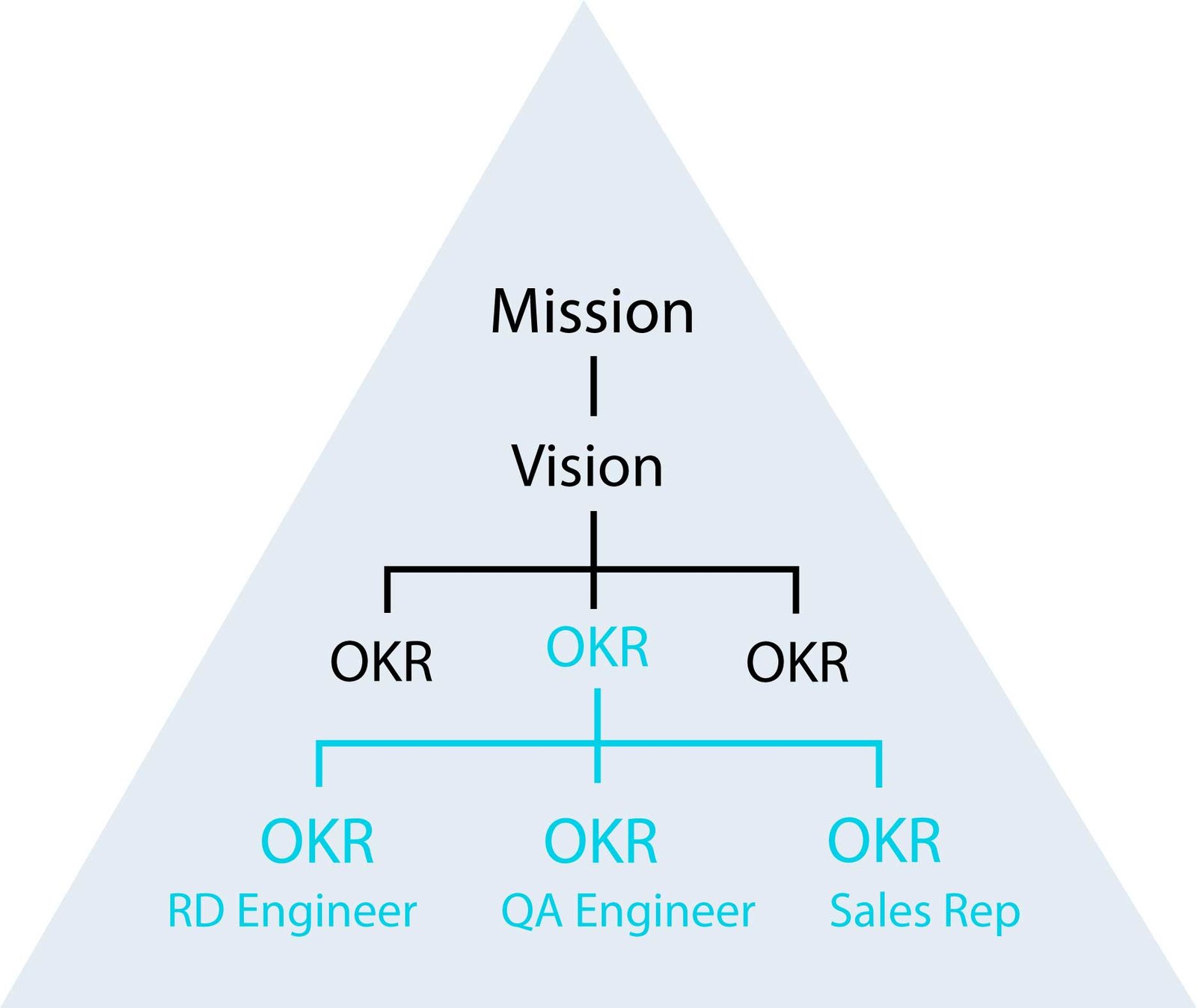
OKR is a hierarchy of goals, not authority.
Learn more about Silos: “OKR vs Departmental Conflict”
3.
It’s OK to Bend the Rules: Let OKRs Adapt to You
While OKRs were designed with structure and discipline in mind, strict adherence to the “rules” often creates friction in real-world environments.
In practice, OKRs are bendable. The degree of flexibility depends on organizational maturity, culture, and operational needs.
Once leaders understand that it’s ok to tweak OKR strategies, much of the pressure around doing them “perfectly” disappears. Teams become free to implement OKRs in ways that fit their own operational reality rather than forcing an idealized model onto the organization.
So how far can you bend OKRs?
As long as you remain true to the F. A. C. T. S. , flexibility is not only acceptable, but oftentimes necessary for a smooth transition.
4.
Track Progress Relentlessly but Not Just for Managers
OKRs are designed to be measurable, which makes progress visible and issues easier to detect.
However, tracking should not be treated as a management-only function. When tracking is assigned only to managers, OKRs simply become a reporting activity.
Tracking progress is the responsibility of the owners of every Objective and Key Result. This places accountability closest to the action where commitments, timelines, and priorities matter the most.
5.
Stay Aligned — Connect Goals to a Higher Purpose
Every Objective must connect upward, to higher-level OKRs, company mission, and vision statements. This alignment ensures that all teams move in the same strategic direction.
In practice, alignment is not always obvious when individuals define their own OKRs.
A simple technique is to connect purpose using the word “to”.
For example, instead of:
“Become the digital marketing expert in the company”
Reframe as:
“Become the digital marketing expert in the company to help position the company as the authority in the industry.”
This small adjustment strengthens alignment and ensures individual effort contributes directly to organizational direction.
6.
Use OKR Software — Not Spreadsheets
OKR adoption is significantly more effective when supported by dedicated OKR software rather than spreadsheets or documents.
Spreadsheets often turn OKRs into messy reporting tools, adding administrative burden and reducing engagement.
Dedicated OKR platforms, on the other hand, provide real-time, online visibility across teams. Everyone can see progress, updates, and ownership without waiting for meetings or manual reporting cycles.
This creates continuous transparency, reduces overhead, and increases accountability across the organization.
7.
Don’t Mandate OKRs — Grow Them
Mandating OKRs across an entire organization often leads to resistance. Teams treat them as another top-down initiative, resulting in disengagement and inconsistent execution.
A more effective approach is gradual adoption.
Start with one or two pilot teams. Demonstrate measurable results. Once other teams observe success, OKRs are more easily adopted.
This approach allows OKRs to grow organically within the organization by building credibility and reducing push-back during rollout.
Learn more “How to implement OKRs“
8.
Integrate Familiar Frameworks
Many companies in Taiwan already operate with systems such as KPIs, MBO, Six Sigma, ERP, SWOT, and CRM. These frameworks are themselves goal-oriented, but often exist in isolation, creating fragmented execution across the business.
OKRs do not replace these systems. Instead, they provide alignment across them.
They create a shared strategic framework that connects different tools and departments back to company mission and vision.
In this way, OKRs act as a unifying layer that brings coherence to existing management systems.
9.
Bridge Strategy and Execution — OKRs and Delivery Teams
OKRs only define strategic direction and outcomes, while delivery teams such as software and hardware departments are responsible for the real execution work.
However, many organizations struggle to connect strategic OKRs with execution.
This is where “initiatives” become critical. Initiatives represent the projects and tasks that drive the work toward reaching the Key Results. They form the bridge between strategy and execution.
Some OKR platforms integrate directly with tools like Jira or Monday.com to connect OKRs to project workflows. Other OKR platforms include built-in initiative and task management features.
OKR principles can also be employed by project teams using the same F.A.C.T.S. concepts, replacing “tracking measurable outcomes” with “tracking milestone dates.” In the end, OKRs are simply sound management principles, whether applied to strategic planning or project execution.
See here “What is OKR vs Project Management“
Conclusion: Adapt OKRs, not force them.
OKRs can be highly effective in traditional Taiwanese tech companies, especially those with strong hierarchical or manufacturing-based cultures.
Most failed OKR implementations occur not because the framework is flawed, but because it is applied too rigidly without company and cultural considerations. This leads to resistance, confusion, and unnecessary administrative load.

When OKRs are introduced through a hybrid approach — simplified principles, cultural alignment, pilot programs, and practical coaching — they become a powerful system for aligning mission, strategy and execution.
Ultimately, the question is not whether OKRs work. It is whether they are implemented in a way your organization can realistically adopt.
Start small. Prove value. Then grow it.
For a free consultation on how you can adapt OKR to your unique culture, industry, and situation please contact us!
Q and A
Can OKRs work in traditional top-down companies?
Yes. OKRs can work effectively in traditional top-down companies when the framework is adapted to fit the company culture. Many Taiwanese tech companies still operate with manufacturing-style management structures, so a hybrid OKR approach often works better than rigid implementation.
Why do OKR implementations fail?
OKR implementations fail for many reasons. One of the reasons is because companies try to apply the framework too rigidly. Overly theoretical approaches, excessive administration, poor alignment, and lack of cultural adaptation often create resistance and confusion within organizations.”
What is a hybrid OKR approach?
A hybrid OKR approach adapts the OKR framework to the realities of a company’s culture, management style, and operational structure. Instead of forcing strict adherence to methodology, organizations simplify and adjust OKRs in ways that employees can realistically adopt.
Should OKRs be flexible?
Yes. In practice, OKRs are bendable and should be adapted to organizational maturity, culture, and operational needs. As long as companies remain aligned to core OKR principles, flexibility often improves adoption and execution.
Why should companies use OKR software instead of spreadsheets?
Dedicated OKR software provides real-time visibility, alignment, accountability, and progress tracking across teams. Spreadsheets often turn OKRs into static reporting exercises, while OKR platforms create a more transparent and collaborative management system.
How do OKRs improve cross-functional collaboration?
OKRs align teams around shared organizational goals rather than departmental objectives. This encourages individuals from different departments to collaborate on solving problems together, reducing siloed thinking and improving organizational alignment.
What is the difference between OKRs and project management?
OKRs define strategic goals and desired outcomes, while project management focuses on executing the tasks and initiatives required to achieve them. OKRs provide direction, while project management handles delivery and execution.
Can OKRs integrate with KPIs and other management systems?"
Yes. OKRs can align and integrate with existing systems such as KPIs, MBO, Six Sigma, ERP, SWOT, and CRM. Rather than replacing these frameworks, OKRs help connect them under a unified strategic direction.

OKR Training Classes in Taiwan
C2believe provides OKR training with classtime, exercises, and coaching.
On Site or Off Site | English or Chinese | In Taiwan (or remote)
- Introduction to OKR for leadership (2 hours)
- Team OKR Class (18 hours) – Classtime, exercises and coaching
- 8-month OKR deployment (coaching and train the trainers)
Contact us about your OKR training needs here





0 Comments