
Listen and follow
Introduction
One of the most difficult aspects of business is, how do you get customers, employees, shareholders to rally around your product and services, your company and your mission. Enter “Storytelling” in business.
Recently, we’ve noticed businesses increasingly using the term “storytelling“. It’s more commonly used in marketing circles but we now find it in strategic planning and even product development. But why do we use storytelling to help us in these contexts? We will explain in this article.

What is a story? Beginning, Middle, and End
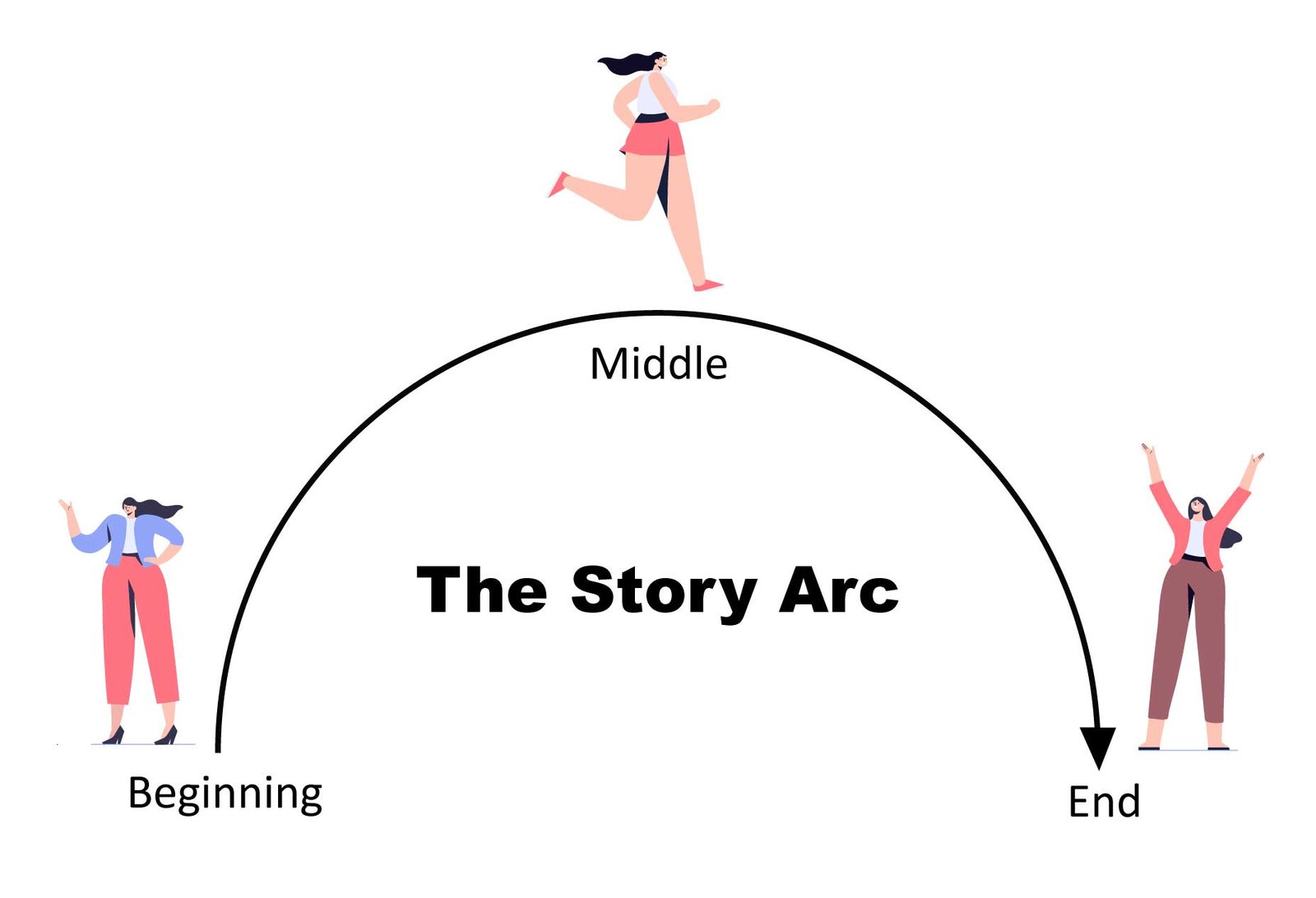
A story is about a person on a journey that usually has a beginning, a middle part and an ending. It’s also referred to as the Story Arc. And the person on the journey is referred to as the hero or heroine.
One way to think about a story is with a customer’s journey. A customer has a problem or a need (beginning). They find your product and services and resolve their problem (middle). Finally, the customer relishes the satisfaction of their achievement (end).
This type of storytelling in marketing is called Brand Story which we discuss later.
Why do we connect with Stories?
Evolutionary roots of storytelling
Before written communications, people perpetuated stories by word-of-mouth. It was a way to pass down legacy and culture for knowledge transfer and even species survival.
In fact, science shows us that our brains light up when there is a story in front of us. Neuroscience studies using MRI and EEG show that stories activate multiple regions of the brain, increasing emotional engagement and memory retention.
See TED Talk “How your brain responds to stories” .
Many researchers theorize that storytelling may have played an evolutionary role in transmitting knowledge and strengthening group cohesion.

The emotional aspect of stories helps us remember.
When we sense happiness, sadness, danger, achievement, or hope, the stimulus feeds our hungry brains and strengthens connections to people, places, projects, products, and companies.
Some facts:
- Stories are remembered up to 22 times more than facts (Jennifer Aaker – Stanford University)
- 92% of consumers want brands to make ads that feel like a story. (Social Targeter)
How do we use storytelling in business?
Perhaps you are starting to see some connections between business and storytelling. It is a powerful medium to connect customers and staff emotionally with your company and mission.
Storytelling in Brand Marketing – Engage the customer.
The customer journey we mentioned earlier is an example of Brand Story – it’s about a customer who has a problem (beginning) that is resolved by your product (middle) and results in a transformative change in the customer’s life (end).
Traditional marketing focuses on promoting bland specs and features. On the other hand, Brand storytelling formulates a scenario that helps the customer visualize how their story will unfold – from the lament of a problem to the intrigue of a solution, and the happy ending – it’s a very personal event that builds trust in your company.
Marketers can apply this format across any material; Ads, DMs, posts, articles, emails etc.
Find out more here: (What is Brand Story?)
Storytelling in Sales – The customer journey
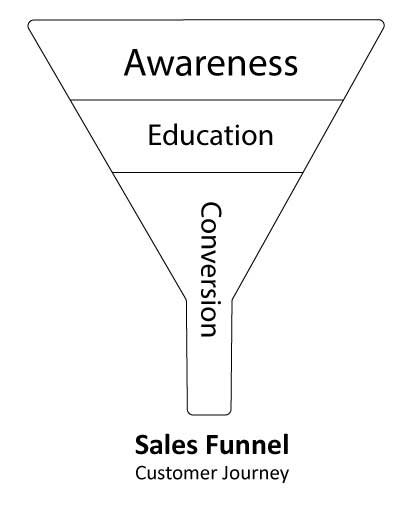
Another example of storytelling can be found in the Sales Funnel. It depicts the customer journey from the initial awareness stage of your brand to the education and exploration about your product and services, and finally to the nudge that entices the customer to choose your brand.
Sales uses this framework to guide the customer through their story, gradually building trust along the way without hard-sell tactics. Eventually the features and specs of your products are infused with that trust to arrive at the conversion point.
Storytelling in Strategic Planning – Engage your staff as players in the story.
Storytelling is a way to help organizations to visualize how things will play out in the complex world of business operations, planning and execution.
It helps them structure their thoughts into the three basic stages – what’s the problem (beginning), what’s the goal (end), and how are we going to get there (middle). And when leadership can articulate intentions in a story-driven way, it invites teams, managers and staff into the story and rallies them to complete the journey.
That’s the essence of storytelling in strategic leadership – inspiring your staff to come to work every day, passionate about their work and committed to a cause.
In Simon Sinek’s book “Start with Why”, he states.
“Leadership requires two things: a vision of the world that does not yet exist and the ability to communicate it.”
Goal-oriented Management Frameworks – Everyone’s a hero.
There can be any number of players involved; executives, managers, front-line staff. But how do you keep everyone aligned, energized and invested? By making them part of the story
A Goal-oriented management framework like OKR draws staff into the story through transparency and inclusiveness – everyone sees themselves in the big picture; What are we trying to accomplish, where are we now, and why you are essential for the story? Once people become the co-heroes of the story, they are compelled to finish it – and that’s employee engagement.
These frameworks don’t just administrate metrics – they script the journey for your staff.
BSC Strategy Maps – the Big Picture
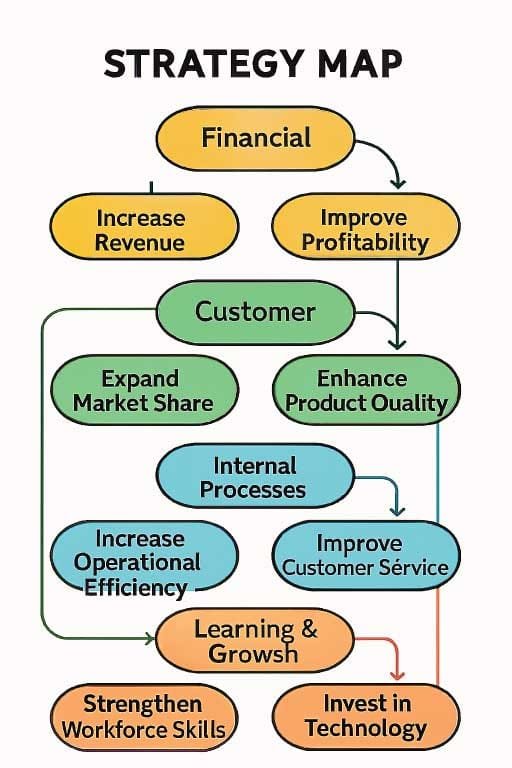
Balanced Scorecard (BSC), another goal-oriented framework uses Strategy Maps, which are a graphic representation of the complete story of how staff and processes get from problem to an intended goal.
Using this big-picture approach is yet another strategy to visualize the whole story not only to organize ideas, but also to draw the planners into the story.
Alignment and Mission – The Saga of your Company Journey.
Your mission fuels an ongoing narrative — not a single project, but a saga. Think of the Star Wars universe: the Rebel Alliance’s mission doesn’t end with one battle or one film. It continues across sequels, generations, and story arcs.
In the same way, a company’s mission is the long-running story that keeps employees engaged. When people understand the mission, they see themselves as part of something bigger than their daily tasks — part of a saga that continues year after year.

Storytelling in Product Development – Heroes.
Agile Scrum has become a popular methodology in hardware and software development. It uses “User Stories” that help engineers keep perspective on what they are developing and why it’s important.
It emphasizes the customer story and what part the engineer plays, which again is the powerful pull of storytelling – The engineers become empowered when they feel the co-hero responsibilities in the story.
Conclusion: Everyone loves a good story.
Storytelling can be applied to almost any aspect of business because companies exist to solve problems. And if you can communicate how those problems are resolved and the impact you make, that’s a story that resonates.
This is why storytelling in business remains one of the most powerful ways to connect customers, employees, and stakeholders. Stories create emotional and even physiological engagement — and once people enter a story, they feel compelled to see it through, whether they’re a customer, marketer, engineer, executive, or shareholder.
Feel free to contact us about story writing skills for your copywriting efforts.
References:
TED Talk – Karen Eber: How your brain responds to stories – and why they’re crucial for leaders | https://www.youtube.com/watch?v=uJfGby1C3C4
Start with Why – Simon SinekHow Great Leaders Inspire Everyone to Take Action (Copyright 2009)
Harnessing the Power of Stories – Jennifer Aaker (Stanford University) – https://womensleadership.stanford.edu/resources/voice-influence/harnessing-power-stories
The Impact of Brand Storytelling on Consumer Engagement: Crafting Narratives that Resonate –https://www.socialtargeter.com/blogs/the-impact-of-brand-storytelling-on-consumer-engagement-crafting-narratives-that-resonate
Q and A
1. What is storytelling in business?
Storytelling in business is the practice of using narrative structures — characters, conflict, and resolution — to communicate ideas, influence decisions, and create emotional connection with customers, employees, and stakeholders. It turns abstract concepts into relatable journeys.
2. Why is storytelling effective in business communication?
Stories activate multiple regions of the brain, increase emotional engagement, and improve memory retention. This makes information easier to understand and more persuasive than facts or data alone.
3. How does storytelling improve marketing and brand engagement?
Brand storytelling helps customers see themselves in a narrative: a problem they face, the solution your product provides, and the transformation they experience. This emotional framing builds trust and increases conversion more effectively than listing features.
4. How is storytelling used in sales?
Sales teams use storytelling to guide prospects through a journey — from awareness to understanding to decision. A well‑structured narrative reduces resistance, builds trust, and helps customers visualize the value of choosing your brand.
5. How does storytelling support strategic planning and leadership?
Leaders use storytelling to clarify goals, align teams, and create a shared vision. A narrative framework helps employees understand the problem, the desired future state, and the path to get there — making strategy more actionable and motivating.
6. What role does storytelling play in goal‑oriented frameworks like OKRs or Balanced Scorecard?
Frameworks like OKRs and BSC work because they create a story: where we are now, where we want to go, and how we’ll get there. This narrative structure helps employees see their role in the larger mission and stay engaged throughout the journey.
7. Why is storytelling important for employee engagement?
Employees stay engaged when they feel part of a meaningful, ongoing narrative — not just a list of tasks. Storytelling connects daily work to a larger mission, helping people see themselves as contributors to a long‑running organizational “saga.”
8. How is storytelling used in product development?
Agile and Scrum use “User Stories” to keep engineers focused on the customer’s needs and the purpose behind each feature. This narrative approach ensures teams build solutions that matter and stay aligned with real user value.
9. Is storytelling only useful for marketing teams?
No. Storytelling is used across the entire organization — marketing, sales, leadership, HR, product development, and operations. Anywhere people need clarity, alignment, or motivation, storytelling strengthens communication.
10. How can a company start using storytelling more effectively?
Begin by defining the core narrative: the problem you solve, the mission that drives you, and the transformation you create for customers and employees. Then apply this structure consistently across communication, strategy, and culture.



0 Comments