

🎧⠀Listen and follow
Introduction
John Doerr, in his book “Measure what Matters”, describes the five OKR Superpowers as a 5-letter acronym to remind us of the powerful advantages of the OKR Framework – the F.A.C.T.S.
- F – Focus on important goals
- A – Align individuals and projects toward achieving goals
- C – Commitment to accomplish goals
- T – Track progress of goals
- S – Stretch for aspirational goals
In this post, we detail the importance of these five crucial features.
New to OKRs, see “What is OKR?”。

🎯 Focus
Choosing what matters most
At any time, an organization may be working on many projects. Teams are often spread thin and not always communicating. Individuals are multitasking and overworked. Consequently, projects never seem to get done.
OKR asks the question, what are the 3-5 most impactful goals in the next cycle.
It encourages us to focus on fewer goals, get them done quickly, and move onto the next priority goals. In this way, OKR is an high-energy, company effort to get priority things done in short time.
But which goals are the “Priority” goals? – that’s not always an easy question to answer but a good place to start is the company Mission and Vision Statements – and then let the goals drive the details and not the other way around.

🤝 Alignment
Rowing in the same direction
Once you have selected your priority goals, how do you get your departments, teams and staff to pull together. This is one of the most difficult considerations for a company.
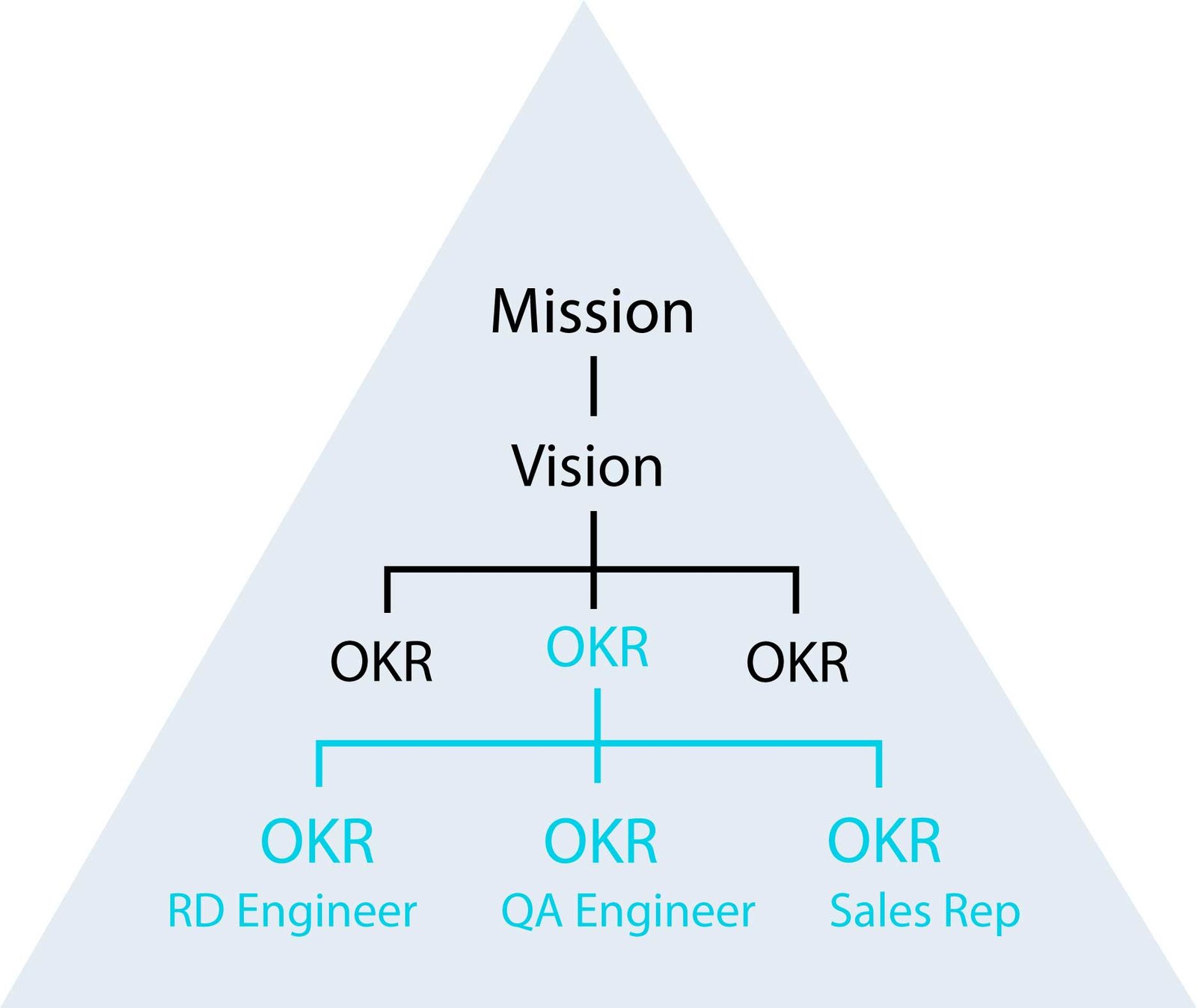
OKRs are a hierarchy of goals as opposed to a hierarchy of authority (Org Chart). This means that projects are not siloed by departmental barriers. Instead, cross functional units of individuals team up to tackle shared priorities and objectives.
Additionally, every OKR is connected to some higher level OKRs and eventually to the Mission and Vision statements of the company. This order ensures all projects, teams and individuals are aligned to a higher purpose.
Read more about “Alignment: Direction, Teamwork, Momentum”。

🔥 Commitment
Counting on you.
An OKR is a promise by the individual to achieve an objective. Individual accountability is driven by owning the planning, execution and tracking of an OKR. Additionally, all OKRs are transparent and visible on a central platform, from front-line staff to the executives, further encouraging responbility.
This open, equal-opportunity, goal-focused teamwork empowers individuals with purpose, determination, and a “counting-on-you” sense of responsibility.

📈 Tracking
Staying on course
Tracking OKR progress allows constant monitoring to gauge the health of an OKR over a period. This is why Key Results are measurable metrics, which helps keep the OKR owner on track, and communicate vital project statuses to managers without the need for micromanaging.

🚀 Stretch
It’s OK(r) to Dream Big
Stretch means to aspire for bigger and better outcomes, sometimes almost lofty in nature. It gives everyone the green light to strive for “Amazing”.
That said, OKRs are less likely to be achieved – At Google, only 70% of aspirational OKRs are expected to be achieved. But the outcomes are always good– when you stretch for the stars, you may not get there, but you are bound to make good progress along the way.
Read more about Stretch“OKR Aspiration, Inspiration and Achievement”。
Conclusion: Why are the F.A.C.T.S. are important.
As you are implementing, training and executing OKRs, it’s easy to let off the gas and have OKR become just another top-management directive.
The F.A.C.T.S. are an easy way to remember and take the advantage of OKR superpowers. They were first enumerated in the book “Measure what Matters” (John Doerr) and is now reinforced throughout other books and training material.
The F.A.C.T.S are a constant reminder to take full advantage of important OKR concepts, strategies and disciplines – It gives purpose and meaning to why we implement OKR.

OKR Training Classes in Taiwan
C2believe provides OKR training with classtime, exercises, and coaching.
On Site or Off Site | English or Chinese | In Taiwan (or remote)
- Introduction to OKR for leadership (2 hours)
- Team OKR Class (18 hours) – Classtime, exercises and coaching
- 8-month OKR deployment (coaching and train the trainers)
Contact us about your OKR training needs here
Look who’s using OKRs.







0 Comments